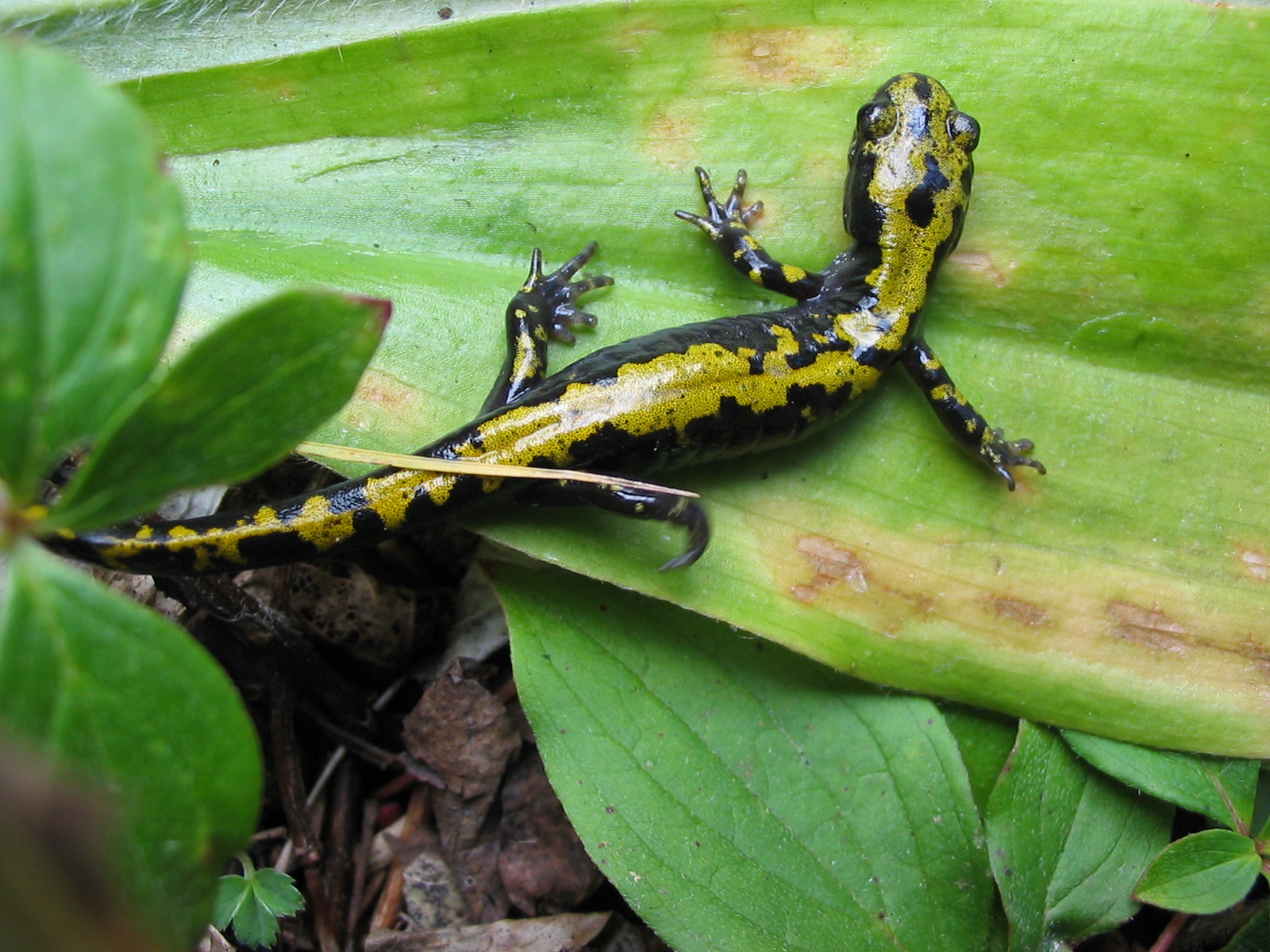
Unisexual Ambystoma

Unisexual Ambystoma
Showing posts with label Evolution. Show all posts

Saturday, November 15, 2014

Required reading: What are we going to do about saving salamanders?

The fungi are coming for all the animals I love.

Frogs have declined across the world. Bats are disappearing from North America. Even snakes! From the outside looking in, our American biodiversity is a hodgepodge of invasive species surrounding smaller and smaller pockets of protected native flora and fauna. 

And now, you may be able to add salamanders to the list. Nooo!

Eastern Newt in red eft phase (Notopthalmus viridescens)

A recent publication in the journal Science describes the threat of a skin fungus that causes massive die offs of salamanders in Europe. Like the fungal pathogens that have caused declines in frogs and bats, this fungus has been introduced into areas where the local wildlife has no evolutionary history with the pathogen, and therefore lacks a natural defense with no time to develop one. In this case, the salamander fungus has an Asian origin and has recently been introduced to naive European salamanders.

So this fungus isn't even in North America? Right, not yet. However, the danger is a real one. North America is THE place for salamanders. We are the Amazon for these animals. You can walk across a few hills in Georgia and see more salamander species than you could find in a coast-to-coast trek across Costa Rica.

Credit to Clinton Jenkins

Here is your required reading if you want to know how to help and potentially make a difference:

1. This news article from the New York Times
2. This excellent editorial by Drs. Karen Lips and Joe Mendelson

Cumberland Plateau Salamander (Plethodon kentucki)


Thursday, August 7, 2014

First publication from SciFund support

The reason I started this blog two years ago was to connect to those who helped fund my science through the SciFund Challenge. Crowdfunding has come a long way, even since then, and I hope that my funders have been able to check back time and again to see how my PhD is progressing. However, after the t-shirts were sent and the thank-yous were written, I haven't shown much about the salamander for for which I was so graciously supported by a group of science-loving citizens.

One thing that is difficult to appreciate about science: it takes a long time. Creating new knowledge is tough. From generating new ideas to collecting and analyzing large amounts of data to having your work evaluated by your peers, even small projects can take years until the product of all that work is produced. 

I'm thrilled to finally have the first scientific publication resulting from crowdfunded support officially in press. The paper is titled "Evolutionary basis of mitonuclear discordance between sister species of mole salamanders" appeared in volume 23 (issue 11) of Molecular Ecology. If you take a look at the acknowledgements at the end of the paper, there is a specific sentence where I send my thanks to all of those who funded my work through SciFund. How cool is that!

The data that was collected for this project was done while I was in the field working on the Ambystoma dispersal project, and my Scifund support was much appreciated during the associated travel across the state of Ohio.

So, that sounds nice, but what is the science?
One thing we noticed when looking at the salamander samples that we had from all across Ohio: some of the species of salamander were showing up in weird places. Particularly, these two sweethearts:


The salamander above on the left is only found in the very southwest of Ohio and is mostly located in Eastern Kentucky. The reason? The Streamside Salamander loves to breed in small streams that don't have fish. In contrast, the Smallmouth Salamander, which is found over most of Ohio and across a wide part of the central United States, only lays its eggs in ponds and other wetlands that aren't streams. 

Here are some of the areas we find these two salamanders ("sympatry" just means they are found in the same county):

BUT, when we used DNA to identify the samples we had from across Ohio, we identified many animals as Streamside Salamanders that we were almost sure were actually Smallmouth Salamanders. 


See all that green in the middle of Ohio? That didn't seem right.

We found these animals in ponds (not streams) and they were well outside of the above range of Streamside Salamanders. Since we only had DNA samples, how could we figure out what was going on?

Because we were using tiny pieces of DNA from the salamanders' mitochondria, there were three main explanations for this unexpected pattern:

The kidney bean thing is suppose to be a mitochondria!

So, we could be observing 1) a misidentification of the central Ohio salamanders or 2) the presence of mitochondria from one species inside the other species (weird!) or 3) hybridization between the two species.

We used DNA collected from both the mitochondria and nuclear DNA of salamanders from all across the state to show that mitochondria inside of the Smallmouth Salamanders in central Ohio are invaders from the Streamside Salamanders, a biological process called mitochondrial introgression

Mitochondrial introgression happens when two species hybridize at some point in time and the mitochondria that comes from the female of one species becomes abundant in the other species, either by natural selection or random chance. As strange as it sounds, the phenomenon is well-recognized and has been identified in a diverse group of animals. 


So why is our publication important? 
First, we solve the mystery of finding salamanders with strange DNA by using a bunch of different genetic techniques. Our methods show the pros and cons of the different ways that scientists have tried to study mitochondrial introgression in the past and provides a guide for how to use these techniques.

Yellow-Rumped Warbler
Second, we took a look at all of the locations where we find salamanders with mismatched mitochondrial DNA and found that these wetlands are located in places with significantly higher rainfall during the spring and summer. This could be a sign of an adaptive link between the foreign mitochondria and a wetter environment.

Making the links between patterns of foreign mitochondria and their adaptive advantages is important and finally becoming common. Other recent publications like ours have shown both advantages (in Warblers) and disadvantages (in Long-Toed Salamanders) to having an introgressed mitochondria. Using genetic information, scientists are finding out what evolutionary processes are happening hidden from sight inside the animals of our backyards. Pretty neat.

Long-Toed Salamander


Thursday, June 26, 2014

Three things from Evolution 2014

I just got back from Evolution 2014, a scientific conference for those who study all aspects of organismal evolution. The conference was held in Raleigh, North Carolina, and I had an absolute blast during my first time at Evolution.

One of my favorite events was Saturday's Evolution film festival. A bunch of short films created by scientists and science educators were screened to a rowdy audience. There were a lot of laughs and nerdery-induced groans. My favorite film ("Dinosaur", below) was catchy and cute, where others varied from humorous explanations of evolutionary principles to fantastic visualizations of scientific studies. You can see all the videos here (some of my favorites include "The Genetics of Mouse Burrowing", "Selfish Gene", and "Drift").


Dinosaur from Lori Henriques on Vimeo.


Here are my biggest takeaways from Evolution 2014:

1. A modern evolutionary biologist needs A LOT of skills. Many presentations I saw described projects that required fieldwork to collect samples (sometimes across continents or the entire globe), laboratory skills to collect huge genetic data sets, bioinformatic techniques to curate and analyze that data,and enough knowledge/perspective to fit conclusions into a rapidly-changing body of knowledge. I tend to perceive a typical PhD student in my field 25 years ago as having a very specific niche, whether that be a certain study organism or a particular technique to collect/analyze data. Based on chatting with other scientists-in-training, a pressure to "do it all" is noticeable, with most students feeling like field, laboratory, and bioinformatic skills were all necessary to get a job.


2. A modern evolutionary biologist needs collaboration. That being said, no one can do it all. That is why I saw (and participated in) so many lunch, dinner, and "quick we have twenty minutes to chat" meetings. Finding other scientists and labs that have experience with what you are interested in isn't hard, and most of the time these folks are thrilled to brainstorm and provide advice. This meeting was a reminder of how much our lab interacts with others around the world and how invigorating these connections can be.


Google "Bad scientific posters" for yourself
3a. Speaking of skills, where are the communication skills? Far and away my biggest complaint about scientific conferences in general is a lack of clarity in communication. At my first few conferences, I struggled to walk through a session of poster presentations and actually learn anything. This caused me to doubt that I was really smart enough to keep up with the rest of science. As I've come to learn, scientists generally have a hard time following some basic rules about communication (for instance, simplify your message and never use comic sans). There is a multitude of potential reasons for this, like a perception that simplicity equals laziness or a lack of understanding. 

Just so you don't think I'm too cocky about visual communication, here is the poster I prepared for Evolution 2014. I've got a lot to learn too!
Even though Evolution showcased some of the most exciting science happening right now, that science was sometimes much to difficult to access (even for other evolutionary biologists!). A 15 minute browse through Dr. Zen's Better Posters blog would have made my brain ache a little less at the end of the night. I will continue to be a proponent for better visual presentation of science, even if at the continued annoyance of my lab mates.


"TWEET"
3b. Speaking of communication skills, some people have them in spades. I saw a lot of great talks from established scientists that demonstrated how powerful good communication skills are when in the hands of gifted minds. For example, Dr. Steve Jones was the recipient of this years' Stephen Jay Gould Award and gave an engaging talk about his career with snails using both art and science. I was inspired by a whole bunch of talks like his.

Also, this meeting was easily the most aware of social media technology of any I have attended. Couldn't make a talk? Need a restaurant recommendation? What posters should I swing by? Just go check the Twitter feed! There was so much Twitter participation at this meeting, and it definitely added something extra for me. I used my own Twitter account to participate, and I look forward to using the spike in blog views and Researchgate publication downloads that resulted as evidence for why tools like Twitter can help you share your work effectively!

Here is a great summary (via The Molecular Ecologist) of the tweeting that was happening and here is a great collection of tweets from the meeting organized by Morgan Ernest (check out her blog, Jabberwocky Ecology too!).


Overall, I can't wait until next time! Now I should get back to making a list of all the new ideas I need to try.


Thursday, June 19, 2014

Small rattles, big personalities

In the dark recesses of Aronoff laboratory, many are surprised to know that our lab has an entire room filled with rattlesnakes. In fact, most visitors don't believe us until we show them. Behind a plain, gray door lives a group of dusky pigmy rattlesnakes (Sistrurus miliarius barbouri). This group of animals has been one of the main sources of data for our lab's efforts in studying pit viper venom and how it relates to these animals diets and behavior. This work is currently being done by our principal investigator, Dr. Lisle Gibbs, and current PhD student Sarah Smiley. 

Right now, one of our undergraduate students (Hardy Kern) is finishing a project examining how these snakes, which have been eating the same type of food for months (either mice or frogs), differ in their interest in other food items. Since some of the snakes were born in the lab, the question is pretty simple: do these animals prefer the only food they've ever known or do they have a preference? I'm sure Hardy will come by at some point to write about his project here, but until then I thought I'd share some photos of the pigmy rattlesnakes that we took as part of Hardy's graduation gift from the grad students. 

The photos show these venomous snakes as we see them: beautiful, gentle, and curious animals.


If seeing snakes in their natural habitat is more your thing, here are some photos of pigmy rattlesnakes we found last summer during a lab trip to Florida:


Wherever you see one, these reclusive snakes are always a treat.


Tuesday, June 25, 2013

The Tweet Report from Evolution 2013

This past weekend, scientists from around the world met in Colorado for Evolution 2013, the largest scientific meeting in the world for folks studying evolutionary biology.

I was not one of these scientists, and I was bummed about it. 

Conferences are very important for scientists for many reasons. They serve as forums to share work that is brand new and unpublished. They allow scientists with common interests to meet face-to-face, creating opportunities for collaboration and generation of new ideas. They can even be places to find your next job!

But from the opposite perspective, conferences are expensive: registration, hotel, transportation, and food add up quickly. And if you aren't there, you miss out. While not every presentation at a conference will become a published academic paper, many of the ideas and techniques presented could pass you by due to the lag time between the completion of scientific studies and the actual publication of those studies. 

However, social media applications like Twitter are now allowing outsiders to get a peak into scientific conferences like never before in addition to giving conference-goers an improved experience. 

Let me show you how. While working this weekend, I had my tweetdeck up monitoring the hashtag #evol2013. Below are some examples of how I got to see who was presenting what and how Evolution 2013 attendees made their conference better with lighting-fast sharing. 

Disclaimer: since all of the below twitter accounts are public, I didn't ask everyone for permission. Keep in mind that they are not endorsing my opinions, and I encourage you to link to their accounts to read all about their various adventures. 

First of all, sharing interesting talks (even your own!) is easy:

Meeting up with like-minded attendees:

Making life easier for conference attendees with schedules, snacks, and saunas:

What are other scientists talking about? Now you know, from the interesting perspectives of respected faculty to the alway-relevant jokes about dress code and grad student scavengers:

Good stuff. I've cherry-picked some entertaining bits above, but in all seriousness, the #evol2013 hashtag allowed me to follow what was going on at the meeting while I was hundreds of miles away. Not only did I benefit from seeing the trends among my colleagues, but I also got a peek at the way scientific conferences are being conducted in the future.