An important component of our lab here at Ohio State is our group of undergraduate students/volunteers/researchers. Even though these students have schedules full of challenging classes, work, and other responsibilities, they still find time to help us take care of captive animals, meet once a week to talk about science, and even conduct their own research. For this blog post, one of our students, Hardy Kern, submitted an article that he wrote up about a topic that has recently captured his imagination. Here's Hardy:
Putting it plainly, I’m an animal
nerd. For as long as I can remember I
have been enthralled and captivated by all aspects of Kingdom Animalia and its
inhabitants. Every single animal,
whether cute and furry or creepy crawly, has something amazing about it; an
adaptation, behavior, or physical trait which distinguish it from the rest and
stop myself and fellow animal nerds in our tracks. What started as a starry eyed fascination
with the natural world has become a drive to study it, taking every special adaptation
or weird inconsistency into effect. Recently I have been focused on (or, truthfully, obsessed with) an
amazing characteristic of reptiles which has received a lot of attention as of
late: parthenogenesis.
Parthenogenesis is a Greek word meaning
“virgin origination.” Basically,
reproduction can happen by a female without a male intervening at all. Asexual reproduction is nothing new to most
people; we know that bacteria can do it, we know it’s how our cells divide, and
the more botanically inclined of us know plants can employ it as well. However, asexual reproduction in a higher
level organism, like a reptile, is a big deal. It’s easy for us to imagine a minuscule bacteria or sedentary plant
fertilizing itself, but for larger and more complex organisms, parthenogenesis
is a phenomenon… or is it?
Partheno-whatasis? How It Works
Since that
awkward birds-and-bees talk we had in middle school with our parents, we know
the basics of reproduction:
Male +
Female = Offspring
But parthenogens throw
a wrench into this unflappable equation:
Female + Herself = Offspring
More or less, she clones herself. When an organism is preparing to breed, it
first needs to make gametes. The female
duplicates her genetic material during mitosis, doubling the original amount,
resulting in a diploid cell which separates into two cells: the original and
its copy. Meiosis then kicks in to
actually make the eggs she’ll use; each of the two cells divide, creating four
haploid cells, where each of the four cells contains all of her genetic
information, but only half as much needed to manifest a new organism.

These four cells are called polar
bodies (above, orange ovals). In regular
reproduction, one of them, the oocyte(1), will go on to become the egg and
await fertilization from the male’s sperm cell (black oval). Sperm + Egg = Enough genetic material to
constitute an offspring. Take the male
out of the picture and you have a lonely, childless female… unless she’s
parthenogenetic. For parthenogens,
there’s a shortcut which removes the male entirely. One of the female’s other polar bodies (2,3,4)
will merge with the oocyte (called automixis), giving it enough genetic
material to make a new organism. Thus is
born our parthenogenetic offspring.
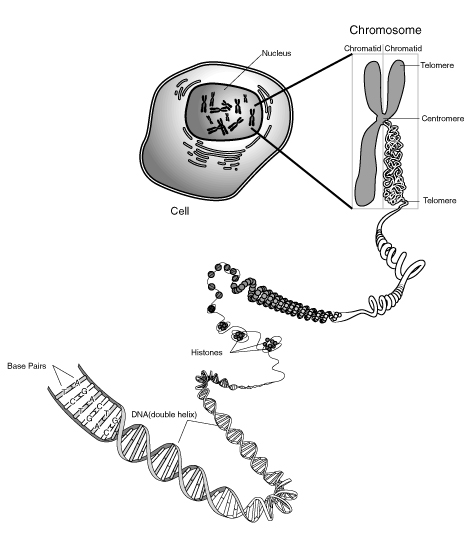 |
| Cells, Chromosomes, DNA: how they fit together. |
Another factor which helps reptiles
reproduce asexually comes from their sex chromosome assignments. In humans, and all other mammals, males have
the XY chromosome combination (heterozygous), and females the XX
(homozygous). In reptiles, this is
switched. Females are the heterozygous
sex, WZ, and males are the homozygous sex, ZZ. Why is this important? For an
organism to be parthenogenetic, its offspring must be able to reproduce without
the intervening of a male. Seeing as
only females are able to give birth, they are the more valuable gender to
“make” in a parthenogenetic species. When the chromosomes separate during meiosis, there are two polar bodies
with the “W” designation, and two with the “Z” designation. Speaking to probability, it is more likely
that a WZ combination will be made than either a ZZ (male) or WW (nonviable)
combination. As females have both the W
and Z designations intrinsically, they can easily make more females.
What Good Is It?
Sexual reproduction has its obvious
advantages, namely the chromosome shuffling which leads to genetic variation
within individuals. When environmental
conditions change, the easiest way for an organism to successfully adapt is to
have mutated genes which may create an individual better suited for the new
environment. Asexually reproducing
organisms do not, for the most part, experience any sort of genetic
recombination; what you see is what you get. An offspring will have the same genetic makeup as its parents. So, why keep
it around?
 |
| Asexual whiptail lizard in Arizona. Photo by Rob Denton. |
For one thing, being a non-recombinant
individual can be advantageous. If an
organism is well adapted for one environment, having offspring which are
equally as well adapted will ensure the progeny’s survival. The babies are born into a world they are
perfectly suited for, all because their mother was. Parthenogenetic individuals also experience
less competition for resources. In a
sexually reproducing species, it can be assumed that both males and females of
that species will require the same resources to self-sustain. This can create a
natural battle of the sexes, as one gender needs to feed, clean, house, and
move itself just as much as the other does.
With no males in a species, parthenogens have the advantage of decreased
resource competition; a whole sector of potential dinner-stealers is virtually
eliminated.
The most successful cases of
parthenogens are typically species which are facultative. Facultative parthenogens are species which
can reproduce either sexually or asexually depending on the circumstance. This method of reproduction is ideal for a
species which lives in an unstable or developing habitat, or which has much
opportunity for habitat expansion. Though asexual reproduction is largely an unconscious decision by the
species in question, certain environmental pressures can trigger either
reproductive process.
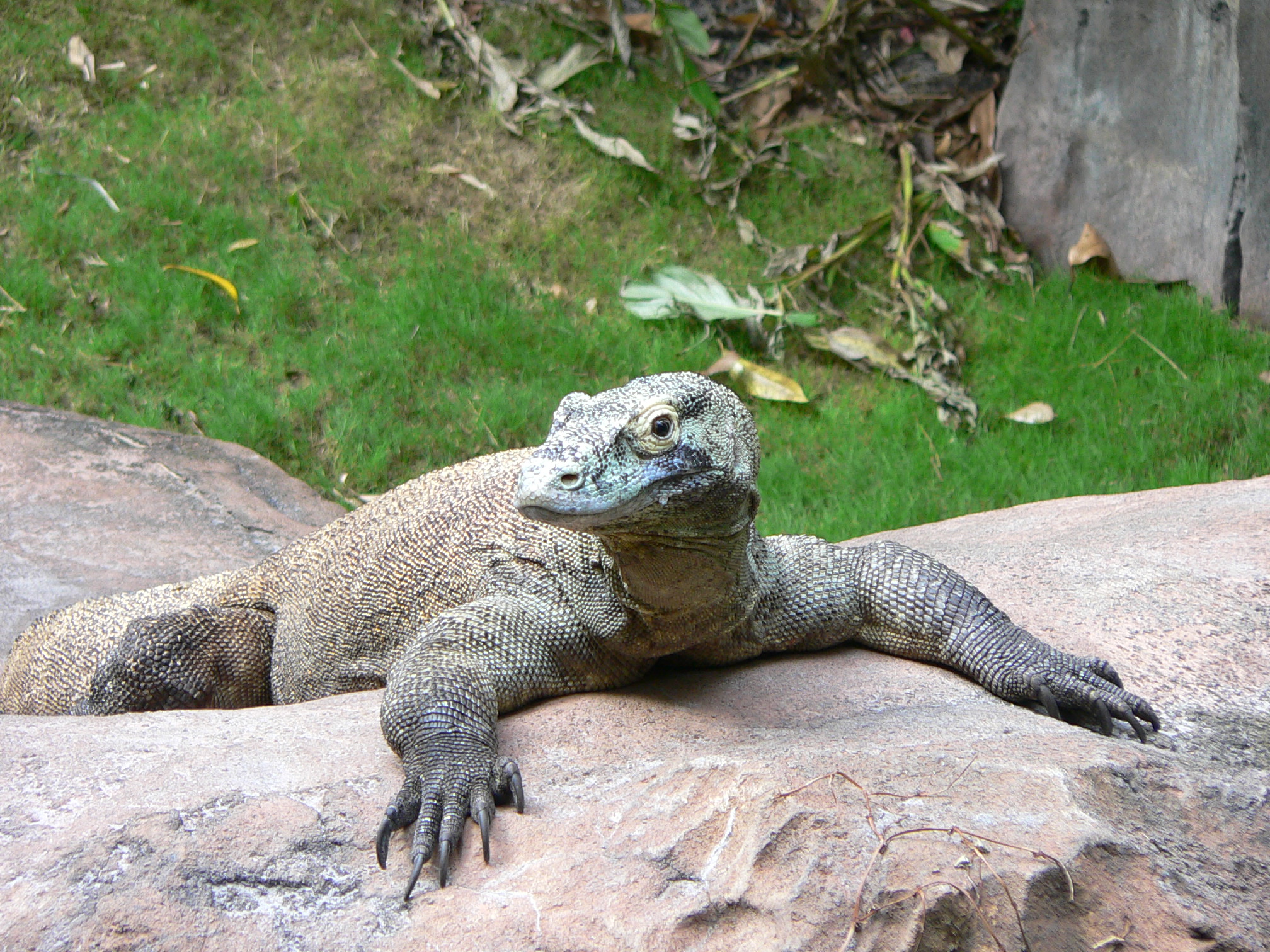
Komodo dragons (Varanus komodoensi) provide an excellent example of a reptilian
facultative parthenogen (try saying that 5 times fast). The prevalent method of reproduction is
sexual; males and females are able to mate and produce offspring whose genes
are a jumble of both of the parents. The
habitat of Komodos is made up of a series of islands. If a female dragon successfully swims to a
new, uninhabited island where there are plentiful resources, her body will know
this is an ideal place to raise young.
With no males around to mate with her, her inherent asexual superpower
kicks in, and she lays a clutch of eggs. Because female reptiles have both the male and female sex chromosomes,
she is able to lay male eggs. Once these
males grow and become sexually mature, they can mate with their mother (whose
pendulum will swing back to the regular reproduction side) and found a sexual
population of dragons on the new island. Virgin Komodo births have occurred in two zoos in the United Kingdom, and quite possibly several times in the United States as well.
The obvious downside to exclusive
parthenogenetic reproduction is a lack of variation. When a species becomes extremely specialized
for its environment, even the smallest of changes can disrupt the entire
population. For this reason, males
become extremely hot commodities in facultative parthenogenetic
populations. In species whose
environment is largely unstable, only females are produced. These parthenogenetic females can create
multitudes more of females with no genetic cost to the species; if 10 females
with the same DNA go out into an unstable environment and 5 of them do not live
to reproduce, no genetic information has been lost from the pool. It is preserved in the other identical
females. Only when an environment has
stabilized will males begin to appear and stay – the genetic variation they
provide is too valuable to risk otherwise.
Is Parthenogenesis Common?
So
far, parthenogenesis has been confirmed in roughly 70 vertebrate species, most
of them reptilian. It has been observed
in pythons, rattlesnakes, monitor lizards, rock lizards, whiptail lizards, and
dozens of others. Most recently it was confirmed that a wild female copperhead, Agkistrodon contortrix, reproduced parthenogenetically – the first observation for that species. Her successful litter of wriggling
young snakes posits and interesting question: just how common is
parthenogenesis? It is entirely possible
that it has been an extremely natural and normal process for millions of years,
but is just now getting our attention. With the wide range of reptiles the process has been seen in, it is
understandable to think that it is common in many more species than just those
which have been extensively studied. There are even some non-reptilian parthenogens out there; chickens and
turkeys in large scale poultry farms have been known to occasionally produce
viable offspring without ever being in contact with a male.
 |
| Copperhead from Daniel Boone National Forest, Kentucky. Photo by Rob Denton |
While we may still be getting our
feet wet in the genetic pool comprised of parthenogens, one thing is entirely
certain: there are always new and amazing things to be found in nature. As an avid animal fanatic, I for one can’t
wait to see what other secrets reptiles, and all other creatures, have in store
for us.
Until
next time,
Hardy
Kern




.jpg)

