Unisexual Ambystoma

Unisexual Ambystoma
Showing posts with label Salamanders. Show all posts

Saturday, November 15, 2014

Required reading: What are we going to do about saving salamanders?

The fungi are coming for all the animals I love.

Frogs have declined across the world. Bats are disappearing from North America. Even snakes! From the outside looking in, our American biodiversity is a hodgepodge of invasive species surrounding smaller and smaller pockets of protected native flora and fauna. 

And now, you may be able to add salamanders to the list. Nooo!

Eastern Newt in red eft phase (Notopthalmus viridescens)

A recent publication in the journal Science describes the threat of a skin fungus that causes massive die offs of salamanders in Europe. Like the fungal pathogens that have caused declines in frogs and bats, this fungus has been introduced into areas where the local wildlife has no evolutionary history with the pathogen, and therefore lacks a natural defense with no time to develop one. In this case, the salamander fungus has an Asian origin and has recently been introduced to naive European salamanders.

So this fungus isn't even in North America? Right, not yet. However, the danger is a real one. North America is THE place for salamanders. We are the Amazon for these animals. You can walk across a few hills in Georgia and see more salamander species than you could find in a coast-to-coast trek across Costa Rica.

Credit to Clinton Jenkins

Here is your required reading if you want to know how to help and potentially make a difference:

1. This news article from the New York Times
2. This excellent editorial by Drs. Karen Lips and Joe Mendelson

Cumberland Plateau Salamander (Plethodon kentucki)


Sunday, September 28, 2014

What's Going On in Science, September 2014


Why student evaluations of teaching are worthless
"The paper compared the student evaluations of a particular professor to another measure of teacher quality: how those students performed in a subsequent course. In other words, if I have Dr. Muccio in Microeconomics I, what's my grade next year in Macroeconomics II?
Here's what he found. The better the professors were, as measured by their students' grades in later classes, the lower their ratings from students."


"This class should start an hour later in the morning. Also, the
teacher shouldn't wear sandals."
This NPR article summarizes a new study that tackles a problem that teachers in academia would love to talk your ear off about: teaching evaluations are horribly broken. If you get high scores from students in teaching evaluations, are you a good teacher? Maybe, but probably not. I've noticed the phenomenon of teaching evaluations (like product reviews on Amazon) consisting of only the most extreme opinions resulting in teachers who just don't care about the feedback.


Wildlife is culture, and culture deserves your tax money
"I mostly write about wildlife. So here is how it typically happens for me: A study comes out indicating that species x, y and z are in imminent danger of extinction, or that some major bioregion of the planet is being sucked down into the abyss. And it’s my job to convince people that they should care, even as they are racing to catch the 7:10 train, or wondering if they’ll be able to pay this month’s (or last month’s) rent."

This lovely New York Times Opinion eloquently states why biologists constantly have a lingering pressure to justify their research in terms of benefits to humans. 


Understanding genetics for the future of medicine
"Various efforts are underway to interpret mutations and compile them in publicly available databases; one of the latest is an online registry to which patients can upload their own data. Eventually, they will be able to see how many other people have the same mutation, and how many get cancer."

Genetic testing is becoming a more and more prominent aspect of individualized medicine. Unfortunately, the pace at which genetic tests are increasingly used is racing ahead of the general understanding of genetic tests and how to interpret them. Until better education about traits, alleles, and heritability can permeate into the public, doctors will continue to be limited by their ability to educate their own patients.


Salamanders: forest vacuum cleaners
"On an average day, a salamander eats 20 ants of all sizes, two fly or beetle larvae, one adult beetle and half of an insect called the springtail. And in doing so, they collectively affect the entire course of life in the forest — and perhaps far beyond."

This article is from back in April of this year, but I can't leave a nice salamander study out in the cold on this blog. You may not see them, but in most woodlands in North America, there are salamanders that make big differences in how ecosystems manage nutrients. While they make look cute and cuddly, salamanders are ultra-efficient, insect-seeking torpedoes:


Monday, September 1, 2014

Salamander Snapchats

With the school year starting up again, it means that the undergraduate crew that I work with in the laboratory at Ohio State are back on campus. They are great to work with. Really great. One of my favorite things about them, aside from their work ethic and trustworthiness, is that they have a fantastic collective sense of humor. Because levity is a big part of my own personal work environment, I encourage joking around extensively while doing scientific work. 

One of our salamander caretakers, Paul, is particularly fond of updating me regularly about how the captive salamanders are doing. However, instead of coming to my office or sending me an email, Paul chooses to accomplish this through funny snapchats. If you don't know what Snapchat is, it is a messaging app for phones that allows the sender to create picture messages that are only viewable for a few seconds.

I thought I'd share some of Paul's work (with his permission). These messages are irreverent and silly and very funny to me. I hope you think so too.


Thursday, August 7, 2014

First publication from SciFund support

The reason I started this blog two years ago was to connect to those who helped fund my science through the SciFund Challenge. Crowdfunding has come a long way, even since then, and I hope that my funders have been able to check back time and again to see how my PhD is progressing. However, after the t-shirts were sent and the thank-yous were written, I haven't shown much about the salamander for for which I was so graciously supported by a group of science-loving citizens.

One thing that is difficult to appreciate about science: it takes a long time. Creating new knowledge is tough. From generating new ideas to collecting and analyzing large amounts of data to having your work evaluated by your peers, even small projects can take years until the product of all that work is produced. 

I'm thrilled to finally have the first scientific publication resulting from crowdfunded support officially in press. The paper is titled "Evolutionary basis of mitonuclear discordance between sister species of mole salamanders" appeared in volume 23 (issue 11) of Molecular Ecology. If you take a look at the acknowledgements at the end of the paper, there is a specific sentence where I send my thanks to all of those who funded my work through SciFund. How cool is that!

The data that was collected for this project was done while I was in the field working on the Ambystoma dispersal project, and my Scifund support was much appreciated during the associated travel across the state of Ohio.

So, that sounds nice, but what is the science?
One thing we noticed when looking at the salamander samples that we had from all across Ohio: some of the species of salamander were showing up in weird places. Particularly, these two sweethearts:


The salamander above on the left is only found in the very southwest of Ohio and is mostly located in Eastern Kentucky. The reason? The Streamside Salamander loves to breed in small streams that don't have fish. In contrast, the Smallmouth Salamander, which is found over most of Ohio and across a wide part of the central United States, only lays its eggs in ponds and other wetlands that aren't streams. 

Here are some of the areas we find these two salamanders ("sympatry" just means they are found in the same county):

BUT, when we used DNA to identify the samples we had from across Ohio, we identified many animals as Streamside Salamanders that we were almost sure were actually Smallmouth Salamanders. 


See all that green in the middle of Ohio? That didn't seem right.

We found these animals in ponds (not streams) and they were well outside of the above range of Streamside Salamanders. Since we only had DNA samples, how could we figure out what was going on?

Because we were using tiny pieces of DNA from the salamanders' mitochondria, there were three main explanations for this unexpected pattern:

The kidney bean thing is suppose to be a mitochondria!

So, we could be observing 1) a misidentification of the central Ohio salamanders or 2) the presence of mitochondria from one species inside the other species (weird!) or 3) hybridization between the two species.

We used DNA collected from both the mitochondria and nuclear DNA of salamanders from all across the state to show that mitochondria inside of the Smallmouth Salamanders in central Ohio are invaders from the Streamside Salamanders, a biological process called mitochondrial introgression

Mitochondrial introgression happens when two species hybridize at some point in time and the mitochondria that comes from the female of one species becomes abundant in the other species, either by natural selection or random chance. As strange as it sounds, the phenomenon is well-recognized and has been identified in a diverse group of animals. 


So why is our publication important? 
First, we solve the mystery of finding salamanders with strange DNA by using a bunch of different genetic techniques. Our methods show the pros and cons of the different ways that scientists have tried to study mitochondrial introgression in the past and provides a guide for how to use these techniques.

Yellow-Rumped Warbler
Second, we took a look at all of the locations where we find salamanders with mismatched mitochondrial DNA and found that these wetlands are located in places with significantly higher rainfall during the spring and summer. This could be a sign of an adaptive link between the foreign mitochondria and a wetter environment.

Making the links between patterns of foreign mitochondria and their adaptive advantages is important and finally becoming common. Other recent publications like ours have shown both advantages (in Warblers) and disadvantages (in Long-Toed Salamanders) to having an introgressed mitochondria. Using genetic information, scientists are finding out what evolutionary processes are happening hidden from sight inside the animals of our backyards. Pretty neat.
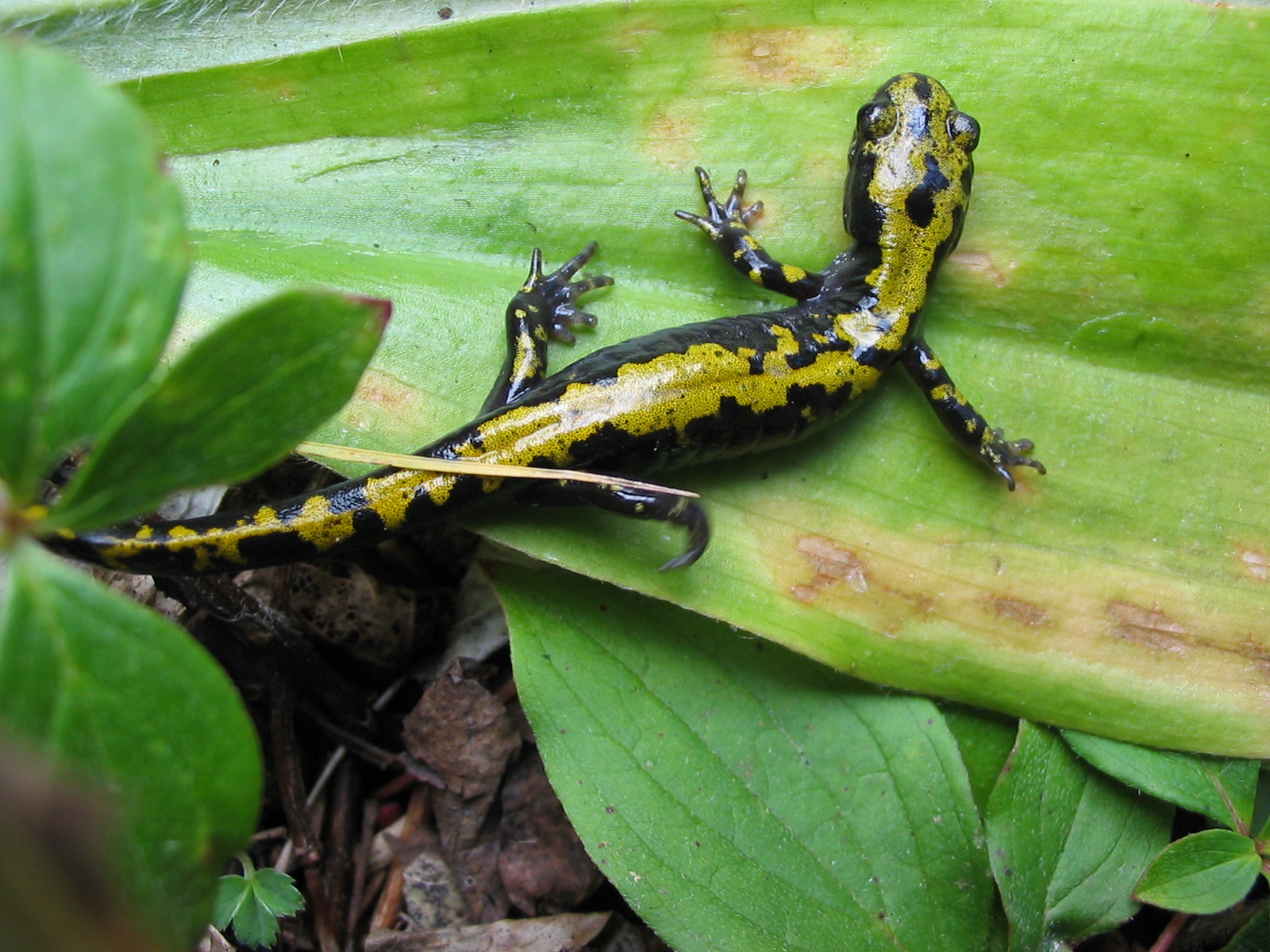
Long-Toed Salamander


Thursday, May 23, 2013

Live slow and die old: why are we studying salamander cells?

The following post was written as part of a practice exercise for the Scifund Outreach Class. But it isn't doing any good hidden away, so here you go:
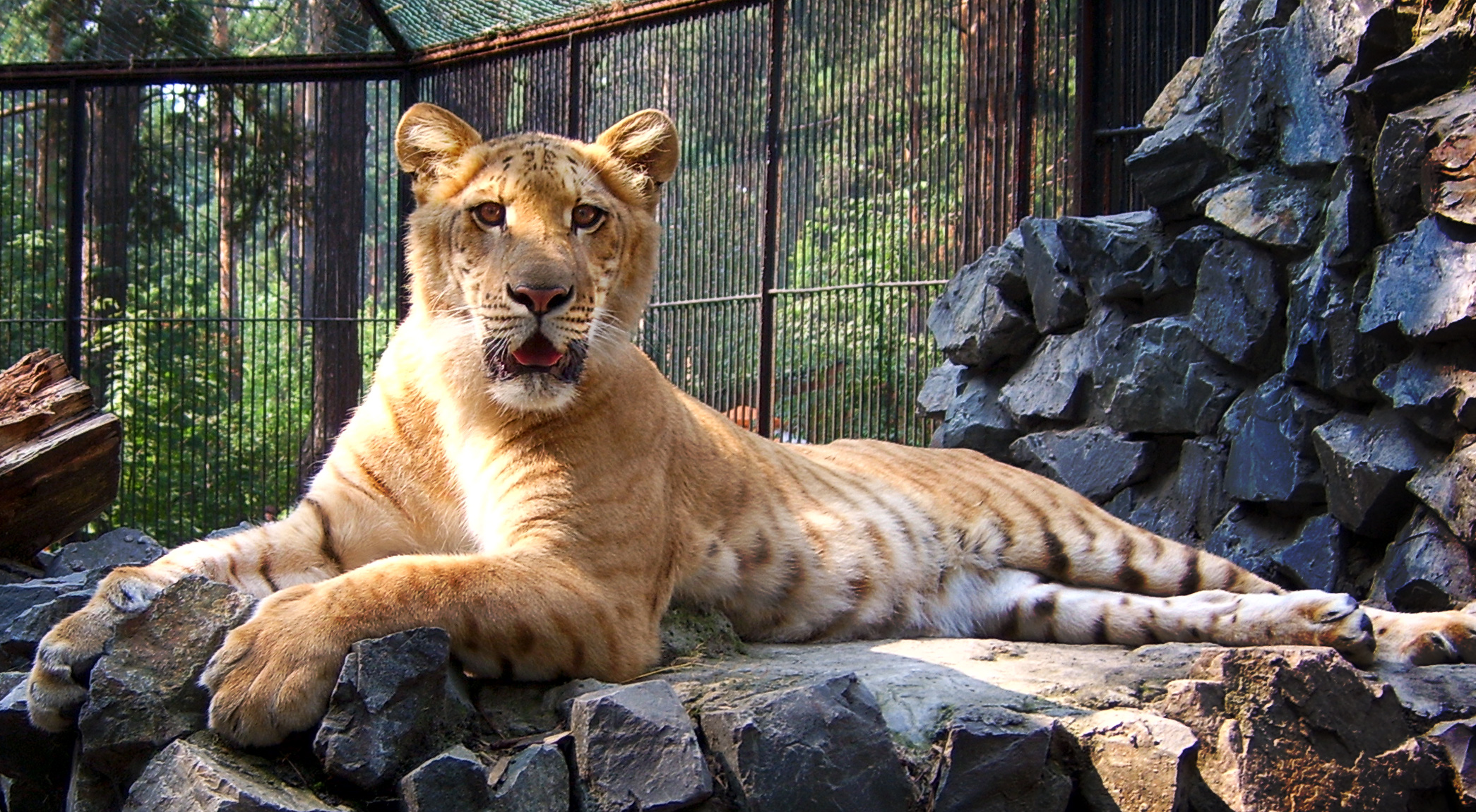
A few years ago, Ligers were all the rage. You remember Ligers don't you?
Here is a Liger looking right at you
Ligers, of course, are the result of a mating between a lion and a tiger. I predict that the reason a hybrid animal like a Liger is so captivating to you and me is that it causes the imagination to run wild. You can't help but think of wild combination of your favorite animals!

However, hybrids are rare. So why won't I ever see a "Growler Bear" (grizzly bear + polar bear)?


The process of evolution has produced many barriers to the creation of hybrids, but one of these barriers could hold the secret to an important question for humans: why do we age?


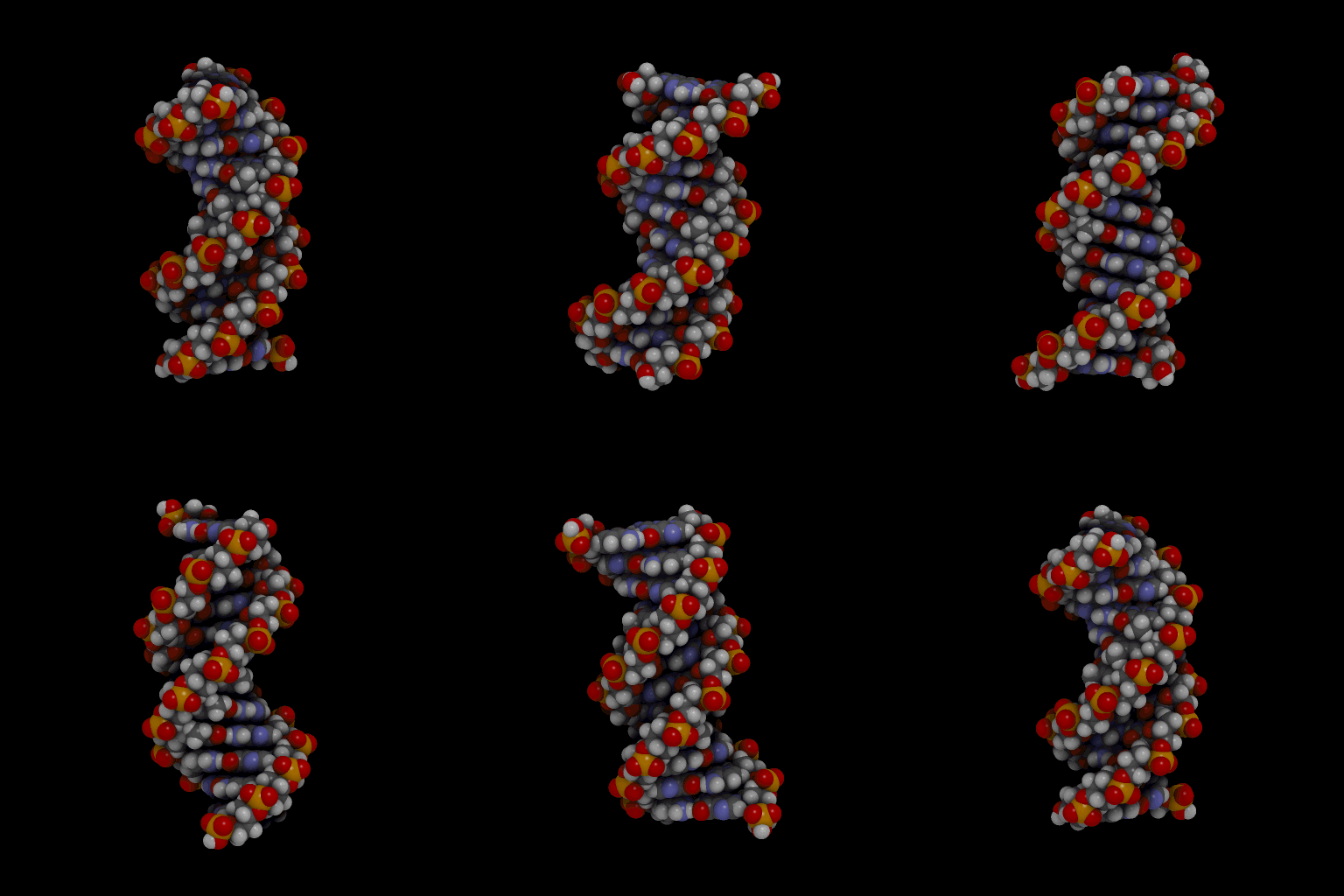
DNA: the answers are somewhere in there.You have to look close!
The key resides in the dual-nature of our DNA. Whether you like it or not, every cell in your body has two distinct sources of genetic blueprints: your mitochondria and your nuclei. These two components of your cells serve very different purposes. Your nucleus acts as each cell's command center by ordering the construction of the proteins that maintain your body and dictate its function. Your mitochondria are the power plants of the cell, constantly creating the fuel that keeps the body running. Each of these components has its own genetic blueprints, but in order for cells to work they must both play nice with each other.

It turns out that playing nice with each other is difficult. Because your mitochondrial DNA is always passed down from your mother and your nuclear DNA is always a combination of both parent's nuclear DNA, the two genetic libraries evolve at two different rates. And the more distantly related nuclear and mitochondrial DNA are from each other, the more difficult it becomes to communicate.

This mismatch is not only a giant barrier to hybrids, but also one of the major contributors to how fast organisms age. This idea is called the "pace of life": organisms with high metabolisms often have shorter lives.

Consider a hummingbird flapping its wings hundreds of times a minute. All that energy requires mitochondria to be pushed to their limits, increasing the pressure for perfect communication between nucleus and mitochondria.


The bottom line: humans would be very interested in how to maintain a healthy dance between their nuclei and mitochondria. We've recently identified an animal that can somehow maintain this dance against almost impossible odds:

An all-female Ambystoma salamander: avoiding cellular destruction while looking adorable.

This salamander is part of an all-female group in the genus Ambystoma. What makes these salamanders special is their ability to clone themselves while occasionally stealing sperm from other salamanders species. The result are cells with multiple copies of nuclear DNA from up to five other related species (imagine yourself with copies of chimpanzee, gorilla, and orangutan DNA). However, their mitochondrial DNA always remains the same. This mismatch of nuclear and mitochondrial DNA spells a recipe for cellular disaster, but these all-female salamanders are widespread and successful. How do they do it?

The first step in answering this question is to determine if these all-female salamanders do in fact overcome this mismatch. To do this, I am growing tissue from different salamanders and comparing the efficiency of their mitochondria. 

At least, I hope I am. I've convinced my committee that it is a pretty good idea.

Thursday, February 14, 2013

NPR and the progress of science crowdfunding

As I was on the way to work this morning, I heard NPR's science reporter Joe Palka doing a story about a very familiar theme: scientific crowdfunding.

The impetus for this blog was my crowdfunding campaign from last year's SciFund challenge, and has been only one example of how crowdfunding has affected my scientific career. I've had much more practice explaining why my research is interesting and important. I've learned how to incorporate principles of marketing and design into the way I present my work to other scientists and the public. The coolest perk of all? It has to be meeting people from around the world who donated to my work and have now become partners for the journey of a research project.

Christmas presents for my SciFund contributors: a photo of their adopted salamander, complete with genetic information.

And what do you know, it looks like crowdfunding might be catching on. The campaign that Joe Palka describes, uBiome, just raised over $250,000
That's gonna buy a lot of pipette tips.

I would have told you last year that it would be impossible for a science project to raise that much money. That is big time grant money. So whether a scientist is attempting a massive project like uBiome or a smaller project like mine, there are folks out there who are willing to open their wallets and support the greater scientific good. What's not to love about that?


Wednesday, June 27, 2012

Salamander Photoshoot

As part of the process of preparing the rewards for my SciFund donators, I'm trying to figure out a good way to get pictures of the salamanders in our lab. I decided to build a small photo studio, inspired by the designs here, and put it in the lab.
 
Not pictured: the work I should probably be doing.
I put this setup together this morning and got some of the animals out to try it out, and the results ended up being better than expected. I am going to try and get profile shots for all of the captive animals in this style before the end of the summer. Check these photos out at full size to get that up-close-and-personal feeling.

A large unisexual Ambystoma salamander

Same big girl as above

A beautiful streamside salamander (Ambystoma barbouri)

One of our tiger salamanders (Ambystoma tigrinum). They are especially tame and can often be found biting the sides of their cages when we walk in the room, expecting crickets.

Awesome!

Wednesday, May 23, 2012

Salamander research featured on The Weekly Wienersmith


  Cool news! I got to talk about our salamander research on this week's episode of Weekly Wienersmith, a really neat podcast about science. You can listen online or download here.

The episode features the work of Dr. Ryan Earley at the University of Alabama. I got to meet Dr. Earley when he came to give a seminar at Ohio State in the winter, and he is one cool scientist. Check out his webpage for some fascinating research on the mangrove rivulus.


Zach and Kelly are super nice and fun to talk to, so go to their webpage and give them some support.

Also, when I talk about folks coming into the field with me to check out the salamanders in the wild, I was serious. Contact me if you are ever interested in tagging along with a scientist in action!


Thursday, May 3, 2012

Plenty of thanks to give on SciFund day 3


SciFund Challenge Day 3 update:

I'm now 32% ($511) on the way to my goal! I've got plenty of folks to thank from the last two days.

Tim Earnest - Tim was my boss during my summer jobs as an undergrad and one of my groomsmen in my wedding. He told me that his oldest daughter wants to name their salamander "Glitter Shine" or "Tim Mannix". Thanks Tim!

Tim Mitchener and Kari Bragg - The first donations to come from family members! Thanks so much Mom and Tim! My Mom was the first to break the $100 barrier, so awesome.

Kyle MacLea - Kyle is a fellow SciFund participant this year and a postdoc at Colorado State University. You can check out Kyle's project here. Kyle studies asexual (just like my salamanders!) crayfish and supporting him will help do some of the first genetic studies of these animals. Check it out!

Stephen Richter - Stephen is my former advisor at Eastern Kentucky University and an all-around great guy who got me some of my first good opportunities in academia. To pay him back, I'm teaching his sons how to play chess.

And last but certainly not least is Ann Fro from South Hadley, Massachusetts. What makes Ann so special? Well, she is the first contributor to my project who I don't know and my project is the first SciFund she has supported. How cool is that? Thanks so much for your generosity Ann!

Thanks again everyone!


Columbus Public Schools Exceptional Science Fair


When I'm on campus, I'm often tied to a computer or a lab bench. While I love the work that I do, this can often get tedious, and many grad students can describe the malaise that sets in after months of working on a project. Sometimes it is difficult to remember the essence of why you love science in the first place.

To remedy this and provide some service to the community, there is always science outreach that can be done. I really got interested in outreach work with my former advisor at Eastern Kentucky University Dr. Stephen Richter and the EKU division of natural areas. I got to talk to a bunch of kids about wetlands and amphibians for two years, and I hope to make more of those connections at Ohio State. 


One of those potential connections, Beechcroft High School, invited our department to participate in this year's Columbus Public Schools Exceptional Science Fair on April 27th. The Exceptional Science Fair is an opportunity for special needs students to present science projects that they have worked on and meet scientists. I loaded up the car with some live animals and headed there with no idea of what to expect. 

 The participants in the Exceptional Science Fair were an incredible groups of students that were curious, determined, and enthusiastic. I could barely keep up trying to answer their questions!


For grad students, I can't recommend community outreach highly enough. It is a brilliant way to make science accessible and reignite some of the emotions that are at the core of scientific inquiry.  

Also, I admire the teachers and staff at Beechcroft for hosting this event. They did a great job of keeping everyone involved and excited. 

Here are some additional pictures of Beechcroft High students and other students from the Columbus public schools enjoying salamanders and snakes!