Unisexual Ambystoma

Unisexual Ambystoma
Showing posts with label Science. Show all posts

Saturday, November 15, 2014

Required reading: What are we going to do about saving salamanders?

The fungi are coming for all the animals I love.

Frogs have declined across the world. Bats are disappearing from North America. Even snakes! From the outside looking in, our American biodiversity is a hodgepodge of invasive species surrounding smaller and smaller pockets of protected native flora and fauna. 

And now, you may be able to add salamanders to the list. Nooo!

Eastern Newt in red eft phase (Notopthalmus viridescens)

A recent publication in the journal Science describes the threat of a skin fungus that causes massive die offs of salamanders in Europe. Like the fungal pathogens that have caused declines in frogs and bats, this fungus has been introduced into areas where the local wildlife has no evolutionary history with the pathogen, and therefore lacks a natural defense with no time to develop one. In this case, the salamander fungus has an Asian origin and has recently been introduced to naive European salamanders.

So this fungus isn't even in North America? Right, not yet. However, the danger is a real one. North America is THE place for salamanders. We are the Amazon for these animals. You can walk across a few hills in Georgia and see more salamander species than you could find in a coast-to-coast trek across Costa Rica.

Credit to Clinton Jenkins

Here is your required reading if you want to know how to help and potentially make a difference:

1. This news article from the New York Times
2. This excellent editorial by Drs. Karen Lips and Joe Mendelson

Cumberland Plateau Salamander (Plethodon kentucki)


Tuesday, October 7, 2014

Old Man of the Forest

Our department's graduate students took our fall camping trip over the weekend to southern Ohio, and we were treated to a really special animal:


That's a big timber rattlesnake (Crotalus horridus) hiding out under some fall leaves. This endangered species is both secretive and well camouflaged, so you could easily walk right past one of these bad boys even if you were lucky enough to be near one.

This particular snake is part of a long-term study to understand the movements and behavior of these snakes in Ohio. A radio transmitter guided the volunteers who track these snakes directly to this individual, and we were lucky enough to follow along.


My lab mate Matt Holding was asked to get DNA samples from this snake over the summer, and he remembered this individual fondly. Here is a photo of Matt with this same snake so you can get a sense of scale. The volunteers said that their last measurement of this individual was 54 inches, and it could very well be 15-25 years old.


So next time you are hiking around in timber rattlesnake country, keep an eye out and you may get to appreciate one of these incredible animals for yourself.

I mean really keep an eye out!


Tuesday, September 23, 2014

How We Work: Dr. Paul Hurtado

Throughout my travels around academia, I've always been very interested in how other scientists work. Scientists in particular make for a great study of working habits for two main reasons: they typically juggle a variety of tasks and they largely determine their own work schedules. This results in a huge variety of work habits: night owls, early birds, multitaskers, focus-taskers, and on and on.

I've been a long-time reader of Lifehacker's "How I Work" series, an interview format in which folks from various organizations detail the secrets behind their work habits. I've always loved this idea: getting a peak into the habits of someone who's work you admire. As I've read more and more "How I Work" articles, I began to think that this format would work really well for scientists. So, in the same vein as the previous "Get to know a grad student" series, I'm bringing you a series of interviews that showcase how scientists get stuff done. I'm calling it "How We Work". 


A big thanks go to the inspiration for these questions, and to Andy Orin for giving me permission to use them. Go read Lifehacker for more neat stuff.


The first subject for How We Work is Dr. Paul Hurtado. I met Paul through OSU's Evolution and Ecology Club, and have since learned he is our resident statistics guru, birding expert, and all-around smart guy. Paul's work focuses on using mathematical models and computational techniques to answer large-scale biological questions (see his research page). In simple terms, Paul is a statistics wiz that thinks of new ways to analyze tricky data.

Location: Mathematical Biosciences Institute (MBI), OSU, Columbus, OH

Current Position: It’s complicated. Technically, I’m unemployed, however I just finished a postdoc at OSU in August and I’m currently negotiating a faculty position at a university out west that would start January, 2015. Fortunately my wife has one more year of funding for her postdoc position, which gave me some flexibility in hunting for jobs.

One word that best describes how you work: Inertia. Hard to get started sometimes, and also hard to stop once I get rolling.

Current mobile devices: Galaxy S4 smartphone


Current computer:
1. Desktop: Windows 8.1 (64-bit) 3.1GHz Intel i7 CPU with 8GB RAM.
2. Laptop: An older Dell Latitude D630 with too little storage capacity and speed.
3. I also have access to a multicore linux server through the MBI which I use occasionally.

What apps/software/tools can’t you live without?
Because I interact with biologists and mathematicians, I prefer to use free (or widely used) software so that licensing issues and/or software costs don’t get in the way of communicating and sharing content.

1. R is my go-to platform for data visualization, stats and model simulation.
2. I occasionally use R Studio – a front-end for R – but I tend to prefer the multi-window configuration of R and use Notepad++ to edit and run R scripts via NppToR.
3. Matlab is usually my second-in-line computing platform
4. MatCont (a Matlab add-on; although I really need to try Auto or XPP-Auto).
5. Maple and sometimes the free software Maxima for computer algebra (i.e., symbolic manipulation of algebraic expressions instead of crunching numbers)
6. I also use Python, Perl, and C from time to time, so access to a Linux command line is a must.
7. PuTTY and WinSCP for connecting to remote servers via SSH.
8. TeXstudio is my new favorite editor for writing manuscripts and other documents in LaTeX
9. Google Calendar is my primary means of scheduling everything.
10. “To Do” lists help me keep my days organized, so I also use apps like Google Keep (or emails to myself) to jot down important ideas and to organize and schedule tasks.
11. Facebook and Twitter have proven to be useful platforms for “crowdsourcing” technical problems, and soliciting advice or other information from friends and colleagues (Facebook) as well as people I've never met (twitter).
12. I can’t seem to go without Microsoft Office, despite my preference for using free software.
13. The internet, so I guess that means my web browser belongs on this list!

You need big screens to display big data

What is your best time-saving shortcut/life hack?
Talk with the right people, at the right time. Sometimes, I need to spend a lot of time wrapping my head around a problem and thinking it through carefully. But more often than not, I’m stuck on something mundane. In those cases, it can really pay off to just seek out someone with the right expertise who can either point me towards an existing solution, or who can help bounce around ideas until we figure it out. Especially when it comes to doing research, it pays to be selective in how you spend you time.

How do you organize all the stuff you have to do?
I should first admit that I've never considered myself to be a well-organized person, and over the past few years I've been spoiled by the flexible schedule that comes with being a graduate student and postdoc. That said, I have found some nice ways of staying somewhat organized:

1. Simple “To Do” lists – either in a smartphone app, a text file on my desktop, in an email, or written out on some scratch paper next to my computer keyboard – are a primary tool I use to prioritize and schedule most of my day-to-day tasks.

2. Software helps immensely with scheduling. I rely on Google Calendar and a note taking app on my phone to help with scheduling.

3. When I comes to organizing my work, a lot of it takes place on my computer, so I have a simple system of keeping work projects in their own folders, and using cloud-based software (e.g. Box, Dropbox, etc.) to sync content across my laptop and other computers. I incorporate “To Do” lists in code comments, text files and emails, etc. as needed. I’ve tried using version control software like Git to manage code revisions and manuscript drafts, however I’ve abandoned them in favor of just saving copies (with the date appended to the file name) and keeping those in their respective project directories. 


Besides your phone and computer, what gadget can’t you live without and why?
For work, my phone and computer are pretty much all I need! I suppose my coffee mug is the next most essential gadget in my arsenal. Outside of work, however, I am a fairly serious bird watcher (Rob: Paul is probably being modest here. Check out his birding resources page and note that he is one of the top 50 birders in Ohio). I rarely venture outside or do any traveling without bringing along a pair of binoculars. Especially during spring and fall migration! 

The first Kirtland's Warbler in central Ohio. Spotted by Paul in 2011.

What do you listen to while you work?
It depends. My musical interests are pretty broad, so if I want music I’ll just leave Pandora on and let it play from a mix of different channels. But, I can get pretty distracted by music. I’m usually better off with a lot of silence or a lot of ambient noise that won’t draw my attention away. For example, I used to be most effective at getting my math homework done as an undergraduate by bringing it with me to the Biology Club’s weekly bowling night and working on it one or two problems at a time. It was pretty effective, but definitely a compromise between getting my homework done and hanging out with friends.

What are you currently reading?
I've most recently been trying to finish up Writing Science by Schimel, which was the book the Aquatic Ecology Lab chose to read for the summer.

Are you more of an introvert or an extrovert?
I’m closer to the extrovert side of the spectrum, but definitely somewhere in the middle.

What is your sleep routine like?
I have a two and a half year old who loves to sneak into bed with us in the middle of the night, so lately my sleep has been pretty variable. I probably average around 8 hours a night but often with at least one interruption during late morning, which takes a toll. Now that I’m a parent, I definitely go to bed earlier (and probably sleep about the same or slightly more on average) although the interruptions definitely take their toll.

I’d love to see _____________ answer these same questions.
Libby Marschall (Ohio State), Liza Comita (Yale), Amy Downing (Ohio Wesleyan)

What’s the best advice you've ever received?
Work hard, play harder.


Sunday, August 24, 2014

Apps for Academia: Let's Talk Tech

A big part of training to be a scientist is training to be productive. Grad students and faculty do a lot of different things in a set amount of time, and that amount of time always stubbornly stays the same or reduces. Improving efficiency not only allows you to have more time for non-work things, but also allows you to devote valuable time to tasks that need creativity instead of efficiency. My advisor often tells us that we are too busy and need more time to sit around and think


As much as technology can be a rabbit-hole of wasted time, I love using tech for helping me stay on task. I thoroughly enjoy talking to other grad students and faculty about what programs, devices, and apps they use to organize their work lives, and I've cherry-picked from them extensively.


Here is a summary of the nine apps that I would be lost in academia without, organized from most essential to most expendable. As a warning, most of these are based on Microsoft Windows, Google Chrome, and Android platforms. Have additions or suggestions? Let me know.

Timesheet
Here is my number one productivity tool and secret weapon against wasted hours, and it is the simplest thing to do. I keep track of how much time I spend doing things. I've written about my experience before, and I have continued to keep track of my hours ever since. In fact, I've gotten so used to it, I can't start working on anything until I glance at my timesheet and decide "Ok, what am I doing right now?".


There are a million apps that keep track of time spent on various projects. I use this one, but they all seem similar.

Any.do
This is my checklist app of choice, and it nicely integrates across my web browser and phone. If I have any task to do, it gets quickly jotted down in Any.do and given a priority. I naturally think of tasks in the same way that they are categorized in Any.do: do this "today", "tomorrow", "upcoming (next week", or "someday". Additionally, I really like the daily reminder function of this app. Every morning when I start my work day (usually 8am), Any.do asks me to prioritize what I'm doing that day. Just a few minutes of considering what is important and what can wait can be super helpful when things get busy.

I used to just write down a to-do list on paper at my desk, but going digital allows me to jot something down anytime. What do you carry with you more often, a notebook or a phone?

Google Calendar
When I was an undergrad, I carried a planner everywhere I went. If you tried to schedule something with me, odds are I was going to forget if I didn't write it down. I'm still the same, except now I don't have to carry the planner and I can share my schedule with ease. Important meeting? "Google, remind me 15 minutes before this meeting starts." 


Mendeley + Scholarley
One of the worst parts of writing scientific manuscripts is controlling the references to other papers. There are different formatting guidelines for each journal, and managing huge libraries of PDFs can be a supremely annoying task. The time I was allotting to formatting citations and finding relevant papers was cut down significantly through the use of a citation management software (Endnote, Papers, Zotero are some examples). 

I prefer the free program Mendeley for a few reasons. One, it is free. Two, it is pretty good at finding information about my PDFs on its own. Three, it plays really nicely with a companion mobile app, Scholarley. Scholarley lets me access all of my Mendeley library on my phone, which is helpful when I'd like to read a journal paper away from the computer. Now I just find an interesting paper online and dump the PDF into a folder on my laptop. Mendeley takes that new file, fills in the details about the paper, and organizes it in another directory.

Maybe the most helpful aspect of Mendeley is using the citation plugin for Microsoft Word. When I'm writing and want to insert a citation, I just click Alt+M, search for topic or author keywords, and press enter. Mendeley adds the citation in whatever journal style I specify and builds a literature cited section for me. Easy.

Cloud Storage (Drive + Dropbox)
Sharing files is necessary for any level of collaboration between scientists, and the cloud storage revolution has been a welcome addition to being scientifically productive. Almost all projects I'm working on have an associated folder in Dropbox or Google Drive, where I can add/view/change content in real time. 

Pocket
Pocket is an app for your phone or internet browser that acts as a glorified bookmarks folder. I had no idea why this would be helpful, but I kept seeing it pop up on websites like lifehacker and decided to give it a try. 


The main advantage of Pocket is the ability to store all the things that I don't have time to read on the internet (blog posts, science articles, discussion boards) into a centralized place. Then when I have time, I can go through and quickly figure out what is worth reading and what's not. Very simple and surprisingly efficient. 

Twitter + Tweetdeck + Plume
I'll tell you what scientists are talking a lot about: using social media. "Uggh, do I have to tweet?" say many. No you don't, but it sure can be helpful. For scientists, Twitter can help your work reach farther, let you know what new science is being talked about, and help you connect to other scientists extremely quickly. Here is an example from my experience where I was trying to find someone who has a treadmill for salamanders. The correspondence below would have taken me at least a few emails and plenty of internet searching. Instead, in five minutes I have two prominent scientists volunteering to help little 'ol me out. How cool is that?


In terms of social media, Twitter hits the time-to-benefit ratio perfectly for me. Part of using Twitter effectively is being a little bit organized. To do this, I use a combination of Tweetdeck on my computer and Plume on my phone. I create columns for groups of people that I follow ("OSU scientists", "Herpetologists") and columns for relative hashtags ("#scicomm", hashtags from conferences). 

Spreed
Spreed is a plugin available for the Chrome internet browser that serves a very simple function. It helps me read much, much faster. Spreed works by taking the text on a page, feeding it to you one word at a time, and eliminating all the extra noise in your head when you usually read.

Now, I would never spreed a scientific journal article. I take my time doing things like looking up words and glancing back and forth at figures. However, Spreed is exceptionally useful when reading news articles, blog posts, and other internet text. 

Another potential downside is how strange you look when someones walks into your office as you are staring a words quickly flash one-by-one on the screen.

Google dictionary
Speaking of looking words up, Google Dictionary is my favorite way to look up word definitions while I'm browsing. Double click a word to see the definition. Simple.


So there you have it. Everybody's different, so what I find essential, you may find laughable. What really matters is that I get this paper done in time to watch the hockey game. 


Thursday, August 7, 2014

First publication from SciFund support

The reason I started this blog two years ago was to connect to those who helped fund my science through the SciFund Challenge. Crowdfunding has come a long way, even since then, and I hope that my funders have been able to check back time and again to see how my PhD is progressing. However, after the t-shirts were sent and the thank-yous were written, I haven't shown much about the salamander for for which I was so graciously supported by a group of science-loving citizens.

One thing that is difficult to appreciate about science: it takes a long time. Creating new knowledge is tough. From generating new ideas to collecting and analyzing large amounts of data to having your work evaluated by your peers, even small projects can take years until the product of all that work is produced. 

I'm thrilled to finally have the first scientific publication resulting from crowdfunded support officially in press. The paper is titled "Evolutionary basis of mitonuclear discordance between sister species of mole salamanders" appeared in volume 23 (issue 11) of Molecular Ecology. If you take a look at the acknowledgements at the end of the paper, there is a specific sentence where I send my thanks to all of those who funded my work through SciFund. How cool is that!

The data that was collected for this project was done while I was in the field working on the Ambystoma dispersal project, and my Scifund support was much appreciated during the associated travel across the state of Ohio.

So, that sounds nice, but what is the science?
One thing we noticed when looking at the salamander samples that we had from all across Ohio: some of the species of salamander were showing up in weird places. Particularly, these two sweethearts:


The salamander above on the left is only found in the very southwest of Ohio and is mostly located in Eastern Kentucky. The reason? The Streamside Salamander loves to breed in small streams that don't have fish. In contrast, the Smallmouth Salamander, which is found over most of Ohio and across a wide part of the central United States, only lays its eggs in ponds and other wetlands that aren't streams. 

Here are some of the areas we find these two salamanders ("sympatry" just means they are found in the same county):

BUT, when we used DNA to identify the samples we had from across Ohio, we identified many animals as Streamside Salamanders that we were almost sure were actually Smallmouth Salamanders. 


See all that green in the middle of Ohio? That didn't seem right.

We found these animals in ponds (not streams) and they were well outside of the above range of Streamside Salamanders. Since we only had DNA samples, how could we figure out what was going on?

Because we were using tiny pieces of DNA from the salamanders' mitochondria, there were three main explanations for this unexpected pattern:

The kidney bean thing is suppose to be a mitochondria!

So, we could be observing 1) a misidentification of the central Ohio salamanders or 2) the presence of mitochondria from one species inside the other species (weird!) or 3) hybridization between the two species.

We used DNA collected from both the mitochondria and nuclear DNA of salamanders from all across the state to show that mitochondria inside of the Smallmouth Salamanders in central Ohio are invaders from the Streamside Salamanders, a biological process called mitochondrial introgression

Mitochondrial introgression happens when two species hybridize at some point in time and the mitochondria that comes from the female of one species becomes abundant in the other species, either by natural selection or random chance. As strange as it sounds, the phenomenon is well-recognized and has been identified in a diverse group of animals. 


So why is our publication important? 
First, we solve the mystery of finding salamanders with strange DNA by using a bunch of different genetic techniques. Our methods show the pros and cons of the different ways that scientists have tried to study mitochondrial introgression in the past and provides a guide for how to use these techniques.

Yellow-Rumped Warbler
Second, we took a look at all of the locations where we find salamanders with mismatched mitochondrial DNA and found that these wetlands are located in places with significantly higher rainfall during the spring and summer. This could be a sign of an adaptive link between the foreign mitochondria and a wetter environment.

Making the links between patterns of foreign mitochondria and their adaptive advantages is important and finally becoming common. Other recent publications like ours have shown both advantages (in Warblers) and disadvantages (in Long-Toed Salamanders) to having an introgressed mitochondria. Using genetic information, scientists are finding out what evolutionary processes are happening hidden from sight inside the animals of our backyards. Pretty neat.

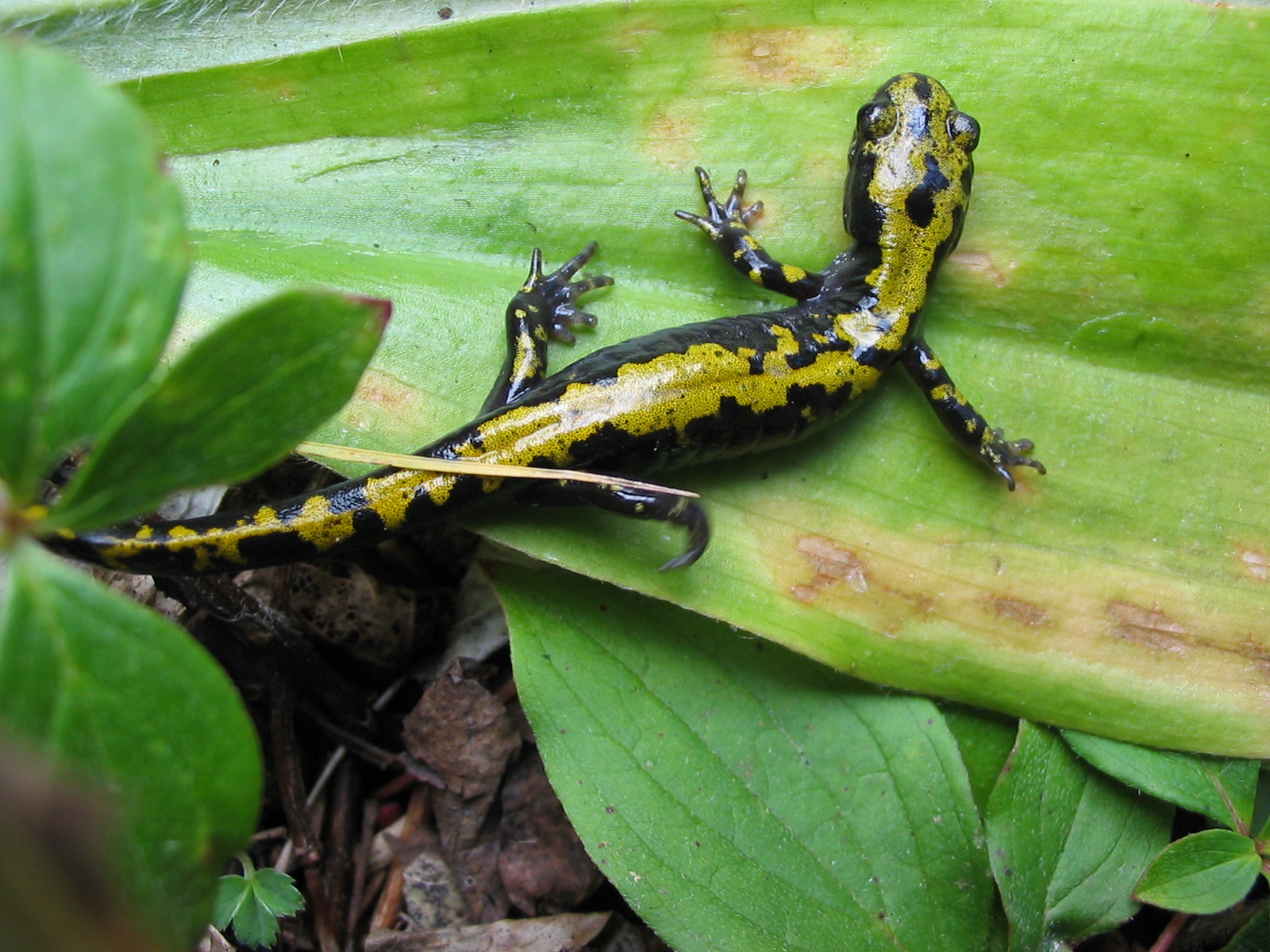
Long-Toed Salamander


Thursday, June 26, 2014

Three things from Evolution 2014

I just got back from Evolution 2014, a scientific conference for those who study all aspects of organismal evolution. The conference was held in Raleigh, North Carolina, and I had an absolute blast during my first time at Evolution.

One of my favorite events was Saturday's Evolution film festival. A bunch of short films created by scientists and science educators were screened to a rowdy audience. There were a lot of laughs and nerdery-induced groans. My favorite film ("Dinosaur", below) was catchy and cute, where others varied from humorous explanations of evolutionary principles to fantastic visualizations of scientific studies. You can see all the videos here (some of my favorites include "The Genetics of Mouse Burrowing", "Selfish Gene", and "Drift").


Dinosaur from Lori Henriques on Vimeo.


Here are my biggest takeaways from Evolution 2014:

1. A modern evolutionary biologist needs A LOT of skills. Many presentations I saw described projects that required fieldwork to collect samples (sometimes across continents or the entire globe), laboratory skills to collect huge genetic data sets, bioinformatic techniques to curate and analyze that data,and enough knowledge/perspective to fit conclusions into a rapidly-changing body of knowledge. I tend to perceive a typical PhD student in my field 25 years ago as having a very specific niche, whether that be a certain study organism or a particular technique to collect/analyze data. Based on chatting with other scientists-in-training, a pressure to "do it all" is noticeable, with most students feeling like field, laboratory, and bioinformatic skills were all necessary to get a job.


2. A modern evolutionary biologist needs collaboration. That being said, no one can do it all. That is why I saw (and participated in) so many lunch, dinner, and "quick we have twenty minutes to chat" meetings. Finding other scientists and labs that have experience with what you are interested in isn't hard, and most of the time these folks are thrilled to brainstorm and provide advice. This meeting was a reminder of how much our lab interacts with others around the world and how invigorating these connections can be.


Google "Bad scientific posters" for yourself
3a. Speaking of skills, where are the communication skills? Far and away my biggest complaint about scientific conferences in general is a lack of clarity in communication. At my first few conferences, I struggled to walk through a session of poster presentations and actually learn anything. This caused me to doubt that I was really smart enough to keep up with the rest of science. As I've come to learn, scientists generally have a hard time following some basic rules about communication (for instance, simplify your message and never use comic sans). There is a multitude of potential reasons for this, like a perception that simplicity equals laziness or a lack of understanding. 

Just so you don't think I'm too cocky about visual communication, here is the poster I prepared for Evolution 2014. I've got a lot to learn too!
Even though Evolution showcased some of the most exciting science happening right now, that science was sometimes much to difficult to access (even for other evolutionary biologists!). A 15 minute browse through Dr. Zen's Better Posters blog would have made my brain ache a little less at the end of the night. I will continue to be a proponent for better visual presentation of science, even if at the continued annoyance of my lab mates.


"TWEET"
3b. Speaking of communication skills, some people have them in spades. I saw a lot of great talks from established scientists that demonstrated how powerful good communication skills are when in the hands of gifted minds. For example, Dr. Steve Jones was the recipient of this years' Stephen Jay Gould Award and gave an engaging talk about his career with snails using both art and science. I was inspired by a whole bunch of talks like his.

Also, this meeting was easily the most aware of social media technology of any I have attended. Couldn't make a talk? Need a restaurant recommendation? What posters should I swing by? Just go check the Twitter feed! There was so much Twitter participation at this meeting, and it definitely added something extra for me. I used my own Twitter account to participate, and I look forward to using the spike in blog views and Researchgate publication downloads that resulted as evidence for why tools like Twitter can help you share your work effectively!

Here is a great summary (via The Molecular Ecologist) of the tweeting that was happening and here is a great collection of tweets from the meeting organized by Morgan Ernest (check out her blog, Jabberwocky Ecology too!).


Overall, I can't wait until next time! Now I should get back to making a list of all the new ideas I need to try.


Thursday, June 19, 2014

Small rattles, big personalities

In the dark recesses of Aronoff laboratory, many are surprised to know that our lab has an entire room filled with rattlesnakes. In fact, most visitors don't believe us until we show them. Behind a plain, gray door lives a group of dusky pigmy rattlesnakes (Sistrurus miliarius barbouri). This group of animals has been one of the main sources of data for our lab's efforts in studying pit viper venom and how it relates to these animals diets and behavior. This work is currently being done by our principal investigator, Dr. Lisle Gibbs, and current PhD student Sarah Smiley. 

Right now, one of our undergraduate students (Hardy Kern) is finishing a project examining how these snakes, which have been eating the same type of food for months (either mice or frogs), differ in their interest in other food items. Since some of the snakes were born in the lab, the question is pretty simple: do these animals prefer the only food they've ever known or do they have a preference? I'm sure Hardy will come by at some point to write about his project here, but until then I thought I'd share some photos of the pigmy rattlesnakes that we took as part of Hardy's graduation gift from the grad students. 

The photos show these venomous snakes as we see them: beautiful, gentle, and curious animals.


If seeing snakes in their natural habitat is more your thing, here are some photos of pigmy rattlesnakes we found last summer during a lab trip to Florida:


Wherever you see one, these reclusive snakes are always a treat.


Monday, February 17, 2014

Who Works 80 Hours a Week in Academia?

Part of being a graduate student is working hard. Whispers of disappearing faculty positions and decreases in funding percentages are heard at most social gatherings. You have to be in the lab 80 hours per week to stay at the front. Right? In this really good blog post, Dr. Meghan Duffy (follow her on twitter here!) presents her argument for why the myth of the 80 hours/week = success equation is pretty silly. 

When I read Dr. Duffy's post a few weeks ago, I had already been intensely thinking about the way I work for about a month. After reaching doctoral candidate status in the fall, I realized that I had a lot of irons in the fire. I also realized I had no real grip on how I spent my time. I knew I was working and I knew I felt like I was working hard, but I needed some more information about my habits. Ya know, data.

So how does a PhD student spend their time? Well, I've been diligently logging all of my work hours since January 14th. I'm no Steven Wolfram, but I put this app on my phone and set up six categories of my work: 
  • General Work: a catch-all for emailing, running small errands, generally finding journal articles, etc.
  • Meetings: anytime I was sitting in a meeting for the lab, the department, or other research activities went here
  • Thesis Research: any activity related to thesis research
  • Other Research: any research, including educational research, that doesn't directly apply to the ol' thesis
  • Outreach Activities: this included both things outside of the university (giving a public talk, preparing materials for outreach events, etc.) and things within our lab (running undergraduate lab meetings)
  • Teaching: any time spend preparing for teaching or preparing for teaching
There is definitely a lot of subjectivity involved when placing actions in one of these categories, but this is what I rolled with for better or worse. Bottom line: whenever I was really working (not surfing the internet) on one of these categories, I was "clocked-in".

How much am I working?
As of downloading the data on Sunday, I've averaged 45 hours/week of real work. I'm working an average of 6.43 hours per day (including weekends). If I look at when I'm working, I start my Monday-Friday work days on average at 9:04 am and head home at 6:40 pm on average. 

Here is a boxplot of the start times of different activities:


This makes pretty good sense compared to my general thoughts about my schedule. I usually have meetings during the morning or midday, handle little things and email first thing in the morning, and often use larger blocks of time in the afternoon for research in the lab or at my computer. I generally go to the gym early in the morning and take time for lunch with other grad students. 

What am I working on?
Since I am not teaching this semester and am being paid through a research assitantship, the data shows that I am (thankfully) working mostly on research projects. The teaching category isn't presented here for the same reason. 

Category: Duration (% of total across 33 days)
General Work: 47.46 hours (22.4% of total)
Meetings: 23.67 hours (11.2% of total)
Thesis Research: 81.28 hours (38.3% of total)
Other Research: 14.76 hours (7.0% of total)
Outreach Activities: 44.99 hours (21.2% of total)

Here is a bar chart showing how I spend each work day on different activities:


I love this view because it primarily demonstrates what I think is so great about being a graduate student: few days are ever the same. Sometimes I can spend the day devoted to a single project and some days I run from place to place doing very different things. For example, on January 30th I spent the whole morning getting some things in the lab organized, had a committee meeting late-morning, ate lunch with the departmental seminar speaker, went to the seminar in the afternoon, worked in the lab for the rest of the day, and then drove to Crawford County in the evening to give a public talk for the Parks District. The following Thursday I spend the majority of the day at my computer writing. Different days produce very different paces and styles of work.

Other observations:
I don't work that much on the weekends. I use the weekends as re-charge time and predominantly spend them with my wife and friends or working on hobbies. I think this is a good use of my time so that's what I do.

Some days are long days and some days are short days. Fridays are generally short days while Mondays/Thursdays are generally long days away from home. I'm not a robot that can work long hours day after day, so long days are usually followed by less work the next day. I can see the sense in this, but definitely see room for improvement. 

How efficient am I?
I wish I had better data to answer this question. Since I didn't log the amount of time I was "trying" to work, it is hard for me to know how many of those hours I was actually working on one of the above categories. 

One thing I was interested in is how long I spend doing each activity. For example, I am extremely fatigued by reading journal articles for more than an hour, but I feel like I can infinitely chip away at a seemingly endless "small things to do list".

Here is another boxplot showing the duration of each activity:


So, generally, I spend an average of about an hour on any given activity, but the duration is awfully variable. The extreme outliers shown here can be explained by the Museum of Biological Diversity Open House (Outreach) and the Ohio Biodiversity Conservation Partnership annual meeting (Meetings). 

But have these been a productive few weeks? I think so. I believe that I spent each of those ~45 hours to get things done. But my whole point here is to quantify what the daily life of a scientist is actually like without the posturing or the caricatures of overworked grad students pulling out their hair.

Haha, yep, there I am.

Besides the obvious benefit of having sweet, sweet data to play with, logging these hours had an entirely unpredicted psychological outcome. It turns out that taking the time to click on my phone and think "Ok, what am I actually going to do right now" is a great exercise in focusing my mind.

I'm now going to click "end outreach activity" and go watch Downton Abbey. See ya.

Wednesday, November 20, 2013

A research lab that herps together, works together

Back in August before the semester began, a good portion of the Gibbs lab headed down to Florida for a week of science and reptiles/amphibians. We were visiting some colleagues/collaborators at Florida State University as well as helping Sarah Smiley catch pigmy rattlesnakes for her thesis research.

Believe it or not, I've just recently downloaded the photos from my camera. Here are some of the interesting things we did and interesting creatures we found:

I almost ordered two slices because I didn't believe that they were "as big as your head".
David and Lisle appreciating the alligators
Sarah took us swimming at Wakulla Springs. We were all brave enough to high dive. 
There I was, expecting a honky-tonk. What a disappointment.
A lifer for me: Pig Frog (Lithobates Grylio)

A handsome juvenile Cottonmouth (Agkistrodon piscivorus)


Matt demonstrating the art form of laying out "rock snakes" to trick other cars searching for snakes at night. Classic.
The snake we were after: The Pigmy Rattlesnake (Sistrurus miliarius)
Sarah studies how these snakes' venom is locally adapted to their prey

Pigmy is a good descriptor. Here are four adult snakes at the bottom of a 5 gallon bucket.
Another lifer for me: Little Grass Frog (Pseudacris ocularis). I thought the first one I saw was an insect jumping through the grass.
Sarah gets the royal treatment during the half of the year she spends in Florida at Stetson University.
It was hot and humid, but we found snakes. Left to right: David Salazar, Sarah Smiley, Terry Farrell, Lisle Gibbs, Matt Holding, Rob Denton